
The Retreat from Excellence: How Postmodern Relativism Undermined Literary Standards

postmodern thought breaks literature

When a culture abandons the pursuit of objective excellence, it doesn’t simply become more inclusive—it becomes incapable of discernment. Over the past three decades, we’ve witnessed a striking decline in literary quality that correlates directly with the ascendancy of postmodern thinking in academia and publishing. The culprit isn’t difficult to identify: when “good is merely a perspective” driven by an esoteric “System of Thought” becomes the operative philosophy, the distinction between mediocrity and mastery dissolves.

The Death of Standards

The postmodern project, at its core, represents a philosophical surrender. Rather than wrestle with the philosophical inconsistencies in Naturalism, then Realism, then Modernism, the postmodernists decided that solving these problems was impossible because truth itself was merely projected by dominant Systems of Thought. By denying that there can be such a thing as “true good” in art, postmodernism hasn’t liberated us from oppressive standards—it has left us defenseless against the tide of the trivial. When every text is merely another perspective, when every voice carries equal weight regardless of craft or vision, the result is predictable: the market floods with work that previous generations would have recognized immediately as unserious. Walk into any major bookstore today and survey the literary fiction section. You’ll find novels praised to the heavens by prestigious review outlets that lack basic narrative coherence, that substitute cleverness for wisdom, that mistake the transgressive for the profound. This isn’t an accident of taste. It’s the logical outcome of a system that has lost the vocabulary—and the courage—to say that some work is simply better than other work.

Academia’s Capitulation

The academy, which once served as a guardian of literary standards, has become their primary subverter. English departments that once trained students to recognize excellence now teach them to deconstruct it. Close reading—that patient attention to how language achieves its effects—has given way to reading for power dynamics, for representations of identity, for the political implications of competing Systems of Thought. These approaches aren’t completely without value, but when they become the dominant approaches, literature ceases to be evaluated as literature. At that point, it becomes far easier to deconstruct the physical words on a page into representations that reflect whatever system the professional academic rewards. I’ve been occasionally surprised on the literary side of X to find academics who have creatively deconstructed religious works into polemics about post-industrial society and other fashionable concerns. The result? Entire generations of writers emerge from MFA programs unable to distinguish between craft and ideology, between a sentence that sings and one that merely signals. They’ve been taught that traditional notions of beauty, structure, and moral seriousness are suspect—tools of cultural hegemony rather than hard-won insights into what makes language live on the page.

Publishing’s Moral Vacancy

The publishing industry, always responsive to cultural currents, has enthusiastically embraced the postmodern turn. Editors who might once have rejected a manuscript for technical deficiencies now celebrate those same deficiencies as formally innovative. Marketing departments that once sought to identify lasting work now scramble to ride waves of social media enthusiasm, no matter how shallow. Consider how contemporary publishing determines what’s worthy of publication. Increasingly, the question isn’t “Is this excellent?” but “Does this fill a slot in our diversity portfolio?” or “Will this generate the right kind of attention on Twitter?” These aren’t questions about literary merit. They’re questions about market positioning and cultural optics—and while both have their place in business decisions, when they crowd out questions of quality entirely, literature suffers. When there is no gate on the process for quality and excellence—even in the absence of political bias—the bottom line becomes the only motivator.

The Evidence Is in the Reading

The proof of this decline doesn’t require theoretical argumentation—it requires only that we read. Pick up a celebrated novel from 2020 and set it beside one from 1950. The difference in linguistic precision, in structural sophistication, in moral and intellectual seriousness is often startling. This isn’t nostalgia speaking. It’s the recognition that when a culture ceases to believe in excellence, it ceases to produce it. The postmodern response to this observation is predictable: “You’re merely privileging one aesthetic over another. Who are you to say Hemingway is better than [insert trendy contemporary author]?” But this response itself reveals the problem. It treats evaluation as an arbitrary exercise in power rather than a learned skill requiring attention, knowledge, and intellectual humility. It assumes that because perfect objectivity is impossible, all judgments are equally subjective—a logical leap that would be laughable in any other field.

Recently, I was discussing books with an adult reading enthusiast who had discovered a new passion for H. Rider Haggard. His books are exciting “lost world” adventures written during the late 1800s, and the writing was considered accessible to young children of that era. My friend was surprised that young boys were drawn to these books in the past, because even the average adult reader would find the writing challenging today. There are scores of examples like this of what we have lost by losing our way regarding excellence in literature.

What We’ve Lost

When we abandon the pursuit of objective literary standards, we lose more than just the ability to distinguish good books from bad ones. We lose the cultural infrastructure that allowed great writers to develop. George Eliot, Tolstoy, Dostoevsky—these writers emerged in cultures that, whatever their other failings, took literature seriously as a vehicle for truth. They wrote for audiences that expected not just to be entertained or validated, but to be challenged, elevated, transformed. Today’s literary culture, by contrast, often seems content with books that function as mere mirrors—reflecting readers’ existing beliefs back to them, confirming what they already think about the world. This isn’t literature’s highest calling. It’s literature’s unflinching surrender.

The Way Forward

The path forward requires recovering what postmodernism has taught us to abandon: the courage to discriminate between truth and falsehood, the willingness to say that some work achieves what other work only attempts. This doesn’t mean returning to a narrow canon or dismissing new voices, but rather means insisting that new voices, like old ones, be held to standards of excellence rather than given passes based on novelty or identity. Editors should be willing to reject manuscripts that fail to meet high literary standards, regardless of their political or cultural appeal. Critics need to be willing to write honest reviews rather than promotional copy. It means readers willing to demand more than what’s merely current or trendy. Most importantly, it means recovering the belief that drove the greatest writers of the past: that literature matters precisely because it can access truth, beauty, and moral wisdom—not perfectly, not infallibly, but genuinely.

When we believe there’s a “true good” worth pursuing in art, we create the conditions for excellence. When we don’t, we get what we have now: a literary landscape cluttered with forgettable cash generators, while genuine talent goes unrecognized because we’ve lost the language to recognize it. The decline of contemporary literature isn’t a mystery. It’s the inevitable result of ideas taken to their logical conclusion. Postmodernism promised liberation from the struggle to define truth and beauty; it delivered mediocrity. The question is whether we have the cultural courage to admit it.

Other Links of Interest

MORE BOOK REVIEWS by Tod Newman

POSTS ABOUT SELF PUBLISHING by Tod Newman

Buy Books authored by the same guy (Tod )

Marce Catlett: The Force of a Story by Wendell Berry

cover art, "Marce Catlett: the Force of a Story"

As a sympathetic agrarian with roots in a place very much like Wendell Berry’s beloved Port William, Kentucky, I am always quick to buy his latest work to hit the market. Pretty much all of my adult life has been spent with characters like Burley Coulter, Jayber Crow, Hannah Coulter, and Andy Catlett. They remind me of generations of my own people, often to a surprising degree. In a sense, Berry’s town has become real to me in a way no other fictional place ever has, even Faulkner’s Yoknapatawpha County. Not only does Port William exist in my thoughts and memories, I often feel longing for what has been lost there.

A Story of Memory and Loss

Berry’s latest novel, Marce Catlett: The Force of a Story, reinforces my sense of loss of the past because Berry spends much time dwelling in that place. The story is about his frequent narrator, Andy Catlett, reminiscing over his grandfather Marce, who managed his family farm behind a brace of mules and a plow. The action starts with a distant event when the tobacco buyers monopoly, the American Tobacco Company, uses their leverage to essentially rob Marce of a full year of labor—not just any labor, but one that was needed to provide a source of scarce income that could augment what the farm itself could offer to Marce’s family.

Andy only knew of this sad story from hearsay, and admits:

So Marce remembered it to Wheeler, who told it to Andy, who in a world radically changed needed a long time and great care to imagine what he heard, but as he has imagined it he has passed it on to his children, for the story has been, as it is still, a force and a light in their place. (p. 17)

The Cost of Progress

One of the familiar complaints made by Berry is that progress in the form of tractors, automobiles, and cross-national linkages of trains changed outcomes for ordinary families who made lives from the soil. Marce sums up his beliefs about progress in describing his journey to Louisville on a train as only a man who was a master of his own work and place could:

They felt in their flesh the ruled line by which the railroad had pierced the living country, subduing its ancient contours to levels and slants and bends required by the machines that ever after would hurry regardlessly across it. (p. 19)

The Black Sheep and the Beloved Past

One well-worn thread through Berry’s books—especially the ones with Andy Catlett as narrator—is that of the “black sheep” that occasionally rose up in these families and found their way in the community. In Andy’s case, this beloved person was his uncle, an attractive rebel of sorts who always wound up involved in schemes and activities that embarrassed those who loved him. As Andy described his Uncle Andrew, “He was instead one in the sequence of feral offshoots that fairly regularly had dissented from it. He was not an outcast, because he had never been cast out.” (p. 57)

In this book, and indeed in many where Andy is the narrator, he is looking back on the past through an old man’s eyes. He recognizes that life has blessed him and that when younger he took it for granted. About this life, he notes that “He did not know how old it was or what it was worth or how threatened it had come to be. He did not begin consciously to honor and love it until he saw it going away.” (p. 68)

Eventually, after a successful period in the “big agriculture” world outside Port William, Andy returns home and regards the life his grandfather lived as his own native culture, one “shared and practiced in common by all the kinds and races of the country people, a possession of incalculable worth.” (p. 68)

A Hybrid Work

There is nothing surprising in this book for a fan of Wendell Berry. What is unique, however, is the mating of Berry’s agrarian thought with the story of one of his characters. This makes this novel a halfway creation between Berry’s fiction and nonfiction writing. It isn’t as captivating as, say, his story-driven novel Hannah Coulter, but it contains much deep thought that the reader who avoids nonfiction might be surprised to learn.

The sadness around the demise of places with history born in love like Port William is palpable. Berry sagely notes that “Port William’s fatal mistake was its failure to value itself at the rate of its affection for itself.” (p. 110) He continues to describe that rather, the town had believed the values imputed on their small place by outsiders who saw progress as a 180-degree path away from the Port Williams of the world.

Who Is My Neighbor?

In the Bible, a lawyer asks a question of Jesus that is logical for one who lives in an elevated place in a community: “And who is my neighbor?” Jesus takes the chance to show the lawyer the extent of his disconnectedness from life and love. In all of Wendell Berry’s books, this question whispers throughout the stories.

In Marce Catlett, we get a very clear declaration:

In stable and lasting communities, people become neighbors to one another because they need one another. The American story so far—which has been so far the Catletts’ story, which they have both suffered and resisted—has been the fairly continuous overpowering of the instinctive desire for settling and homemaking by the forces of unsettling: the westward movement, land greed, money hunger, false economy. The industrial replacement of neighborhood by competition and technology moves everything worthy of love out of reach. (p. 112)

A Vision of the Beautiful Land

Near the close, Andy’s memories of community, family, and neighbors have connected and are now one recollection:

His remembering and his thoughts have carried him by now far outside the matter of fact of this world’s present age. He stands now with his father and his father’s father, and with others dear to them, in the presence of a longed-for beautiful land that they have desired as if seen afar, that yet is the same, the very land that they have known and that they know, a love-made land, dark to them until by their own love they came to see it. (p. 144)

The reader is left uncomfortably wondering if in our new age of progress, this ascendancy of life is any longer possible.


Marce Catlett: The Force of a Story is a meditation on memory, community, and the cost of what we call progress—essential reading for those who long for something beyond efficiency and growth.

Other Links of Interest

MORE BOOK REVIEWS by Tod Newman

POSTS ABOUT SELF PUBLISHING by Tod Newman

Buy Books authored by the same guy (Tod )

A Solar System Built on Magic: Michael F. Kane’s “After Moses”

after moses by michael f kane

Frank Herbert’s Dune series is famous for its intricate world-building. Herbert meticulously explains the systems, methods, and politics that allow humanity to expand across the universe. He answers every question about plausibility before readers can ask it.

Michael F. Kane takes a different approach in his series beginning with After Moses—and it’s refreshing.

Kane clearly draws inspiration from Herbert. His chapters open with quotes from historical figures within his universe, and his stories unfold across a colonized solar system. But instead of exhaustive explanations, Kane uses a brilliant narrative shortcut: an AI named Moses once arose, solved humanity’s greatest challenges, and then vanished without a trace. Hence the title—everything happens “After Moses.”

This device liberates Kane’s storytelling. How do humans live on Ganymede? Moses invented gravity plates and environmental barriers. It’s reminiscent of Gabriel García Márquez’s magical realism—the extraordinary simply exists, everyone accepts it, and life continues.

With technology explained away, Kane focuses on what matters most: character development.

Each chapter tells a self-contained story where characters face captivating challenges. The situations often seem dire, yet Kane’s light touch keeps readers from feeling overwhelmed. You trust these characters are equal to their trials. As the chapters accumulate, a larger narrative emerges, revealing the characters’ backstories and interconnections. And always, the central mystery lingers: Who was Moses, and what happened to him?

Kane’s writing style will feel familiar to fans of Douglas Adams’ Hitchhiker’s Guide series. He has that same gift for witty banter and knows how to make you smile while telling a serious story. I found it thoroughly enjoyable.

If you’re searching for a new sci-fi author—especially one who writes honest stories about characters overcoming struggles with moral integrity—visit michaelfkane.com to purchase the series. Kane is an independent author well worth discovering.

Other Links of Interest

MORE BOOK REVIEWS by Tod Newman

POSTS ABOUT SELF PUBLISHING by Tod Newman

Buy Books authored by the same guy (Tod )

The Road by Cormac McCarthy: Hope in the Ashes

Image of a Road passing through a Stark Landscape

“You have set up a banner for those who fear you, that they may flee to it from the bow.” —Psalm 60:4

In Cormac McCarthy’s The Road, the unimaginable has happened, perhaps across the whole earth. The reader learns of this through the eyes of a man (the Man) and his son (the Boy), and what McCarthy tells us through these two characters’ senses is stark. As with King David, who spent large portions of his life fleeing those who would take it, the characters are beset at every step—scavenging for the ever-more-unlikely can of food through abject danger from those who have learned to place all things below their own survival. Slavery, murder, and cannibalism are the tools the remaining few on Earth have learned to boost this urge to survive at the expense of all others.

But yet, there remains a banner of goodness, of hope, of God that barely remains. The reader frequently descends into disillusionment. Is this what might happen if human kindness descends fully into self-centeredness? McCarthy’s gritty prose sets the temperature of the novel throughout. Sparing with words, neglectful of polite punctuation, he serves up the most basic elements of a collapsed society. But still there are two who continue to hold the “fire” inside.

A Father’s Divine Charter

The Man—though he is one of the few survivors of the cataclysmic events that have destroyed most of the world’s flora and fauna—has a charter. He sees this as a gift from the God who has taken literally everything else away. Early in the novel as he scans the terrain for threats to his day’s journey down the cracking and bubbling interstate to the coast, he ponders this unclear but divine call.

“He knew only that the child was his warrant. He said: If he is not the word of God God never spoke.” (p. 3)

The descriptions of this fallen world abound. I have a hard time imagining any author other than McCarthy being able to communicate something so unthinkable to our expectations of excess.

“The ashes of the late world carried on the bleak and temporal winds to and fro in the void. Carried forth and scattered and carried forth again. Everything uncoupled from its shoring. Unsupported in the ashen air. Sustained by a breath, trembling and brief. If only my heart were stone.” (p. 10)

Or the tyranny of needing to search for food in forsaken places that have been multiply ravaged by bands of nihilistic scavengers:

“In the morning they went on. Desolate country. A boar-hide nailed to a barndoor. Ratty. Wisp of a tail. Inside the barn three bodies hanging from the rafters, dried and dusty among the wan slats of light. There could be something here, the boy said. There could be some corn or something. Let’s go, the man said.” (p. 16)

Of the sadness of what has been lost, the reader is given this to experience as the Man inspects the fireplace of an abandoned family home for anything that may assist his survival:

“He felt with his thumb in the painted wood of the mantle the pinholes from tacks that had held stockings forty years ago.” (p. 25)

Mastery and Purposeful Protection

Notable is the absolute mastery of the small, important things of the world that the Man has been able to demonstrate. McCarthy uses this, perhaps, as a foil to demonstrate how even the most competent and experienced can be beset by an evil world. Thinking here about King David in the wilderness. The Man knows how to survive. How did he learn this? Through good preparation before the disasters occurred? Through hard effort and good fortune afterwards? This remains unclear to the reader at the end of the novel, but what is made certain is that the Man has “the fire” to refuse to allow the evil to take him before he can develop his son into a Man who can survive the new reality. This book gives the reader much pause on the difficulties of the intentional protection and development of others.

Hints of Hope

The careful reader will seek out the hints that McCarthy provides of the persistence of the human spirit. They are few and can be missed. The Man takes some roadside cane and makes his son a flute as a distraction:

“The boy took it wordlessly. After a while he fell back and after a while the man could hear him playing. A formless music for the age to come. Or perhaps the last music on earth called up from out of the ashes of its ruin.” (p. 81)

And as the Boy struggles with the painfulness of his existence and his desire to take a blissful-appearing death—like his mother had quietly done:

“You can’t. You have to carry the fire.” (p. 298)

The Real Story

Though this book won a Pulitzer Prize, many reviewers have chosen to wallow in the meaninglessness that McCarthy is able to weave while describing an utterly fallen world. Even Haiti in 2026 has not yet fallen nearly as far. I’ll admit that it is a true challenge to see through all the depressing atmosphere.

But the real story of the novel is McCarthy’s knowledge that even in the worst possible case for humanity, hope will somehow survive. Some of the very last words are spoken in hope about the Boy (and perhaps others like him yet to be met):

“The breath of God was his breath yet though it pass from man to man through all of time.” (p. 306)

The Road is well worth reading, even by more sensitive people. It speaks of preparedness, resilience, and the humanity of passionately holding to hope, even when the senses scream that hope has been destroyed and placed in its grave. Because then the spark is lit and who is to say what God will do with it.


Have you read The Road? What did you discover about hope in the darkest places? Share your thoughts in the comments below.

Other Links of Interest

MORE BOOK REVIEWS by Tod Newman

POSTS ABOUT SELF PUBLISHING by Tod Newman

Buy Books authored by the same guy (Tod )

Travel by Star: A Journey of Hope and Redeeming Joy

Travel by Star Cover Image

There is a place in C.S. Lewis’ Prince Caspian where Aslan returns after a long absence from Narnia and utter joy ensues. It is a wild passage. Bacchus arrives—young and virile—along with dancing girls known as Maenads. Grape vines begin erupting from the earth and covering anything available. It appears like Lewis’ organized, methodological storytelling is about to detonate into chaos.

But then in a conversation with her sister, Lucy (the youngest) offers this steadying moment: “I wouldn’t have felt very safe with Bacchus and all his wild girls if we’d met them without Aslan.” And thus we see the redeeming of the recklessness that we perceive into blessed joy.

Paul Scott Grill’s novel Travel by Star is clearly influenced by many of the works that my writing is also touched by. The Narnia series, Tolkien, Pilgrim’s Progress, and even Louis L’Amour appear to be prominent. This makes for a read that is personally quite thrilling.

Note that Mr. Grill is a current author who has chosen the independent publishing path. This approach frees one from the conforming biases of the publishing industry and allows full creative control. Unfortunately, it also may discourage the buying public who sees the independently published novel as potentially lesser. I tend to feel the opposite way.

This is why I will be buying and reviewing (unbeknownst to the author) independent novels here on my site from time to time. I hope this will be a positive deviation from my traditional Classics reviews. Perhaps it will be helpful to both authors and readers who want better content not influenced by “the industry”. Back to the review.

Western Grit Meets Magical Wonder

In places, we see the western stability and rugged individualism characteristic of L’Amour and we garner a notion about the type of book this is. But then the magic and joy of Grill’s world building erupts out of nowhere and takes the reader into an exciting new place for a short while. Once control is regained, we resume the main story—or is it the main story? We don’t know for sure because the author maintains suspense for quite a long time.

Three characters garner the majority of the love from Grill. The main Clint Eastwood plains drifter (or plains Runner as the book describes him) is named Travel. Early on he meets a challenging and powerful young woman named Nichole who has a mission she needs Travel’s attendance to. He has various beliefs about what this mission is, and even though he’s initially reluctant (of course, the heroic journey is featured here as with many of the best novels), eventually he becomes invested, though he still is mistaken about the purpose. Nichole is compelling and surprising throughout, but Travel begins to truly care for her. We learn a truth about Travel and Nichole fairly early on:

“Nichole lived in a haunted world, as did Travel, as did everyone else. It was a world where nothing beautiful could ever rise up without something coming for it.” (p. 102)

This is excellent foreshadowing, but as with heroes in our own real world, neither of these two is affected by these challenges, constantly adapting and seeking to overcome.

My favorite character is perhaps more of a mighty supporting character, a “protector” named Hatchet who is also far more than he appears. What I appreciate about this character is the clothing in humility and grace Grill provides him that enables him to serve and regard the other characters in the novel far higher than himself.

Magical Realism Done Well

Magical realism is featured throughout, often in surprising ways. As with García Márquez, the best examples of this are short and never get fully resolved in the book. This lends these moments a great amount of interest.

Hope as Our Sure Possession

My opinion on the main theme in the novel is that it continually returns to hope. For example, much of the story revolves around searching for a majestic city (à la the Celestial City from Pilgrim’s Progress). Travel isn’t so sure at the beginning of the book, but we learn his thoughts and get insight into his character:

“Travel shrugged. ‘I believe there was once a city, and I’m sure it had its day.’ He paused, and the watchfulness returned. ‘But I don’t believe anything can sustain that kind of hope.'” (p. 86)

I highlighted the theme of hope throughout my Kindle edition of this novel. One phrase that is repeated by many characters is initially thrown out as a surety by Hatchett: “Hope is our sure possession.” How much do we need to hear this in our own era where we have sacrificed hope to the mere tangible? It is food for much thought.

There are many smaller characters like Nivenna who pursue this hope through strenuous and systematic sacrificial investment in the advancement of others. We learn that Nivenna is training groups of young women to become anchors in the community. Grill writes:

“For in addition to the well-known work and provision of their land, there was a quiet, lesser-known work that also sustained the town, whereby these four women took in wayward girls and taught them how to set their sights on something more than the day after. Here, they learned to read, to make plans, to keep a schedule, to garden and cook, to care for animals, to care for people, to stretch a coin and mend a seam and close a wound. These were Occam’s Daughters, and they did more to keep the town from descending into a brothel-pocked ruin than most would ever know. It was dangerous work.” (p. 153)

Those who love horses (like me) will also enjoy this book, for there is a race of horses that are higher and more noble. Perhaps these horses even aspire to the Greek legends of Pegasus, the winged symbol of divine inspiration. What is certain is that they are critical partners to the human teams seeking the blessed city in full hope.

The Journey’s End—and Beginning

Near the end of the book, Travel reaches the City. But has he? He is uncertain, for he detects some adjacent injustice. He meets an important character in a dingy room who addresses the whole issue about the City and the remnants of evil:

“Do not fear him,” he said. “As for you…” he stopped for a moment, and it seemed then that he looked past Travel, at something the horsemaster could neither hear nor see. The Man smiled briefly then returned his gaze. “Did you think I could bring you all the way here, and not finish what I’ve begun?” he asked. (p. 603)

With this advice, Travel moves forward confidently and hopefully into his new life’s work, no longer unaware of who he is and who he is serving.


Travel by Star is an enjoyable read that will alternately leave your head spinning and then focus your attention on the reality that underlies and sustains all of the many symbols that Grill sneaks past our attention.

Other Links of Interest

MORE BOOK REVIEWS by Tod Newman

POSTS ABOUT SELF PUBLISHING by Tod Newman

Buy Books authored by the same guy (Tod )

Waverley: When Privilege Meets Rebellion

The Battle of Culloden by David Morier

When Sir Walter Scott published Waverley anonymously in 1814, he ignited a literary sensation across Europe. The novel succeeded for two compelling reasons: it revived historical fiction as a popular genre after centuries of dormancy, and its anonymous authorship sparked intense speculation about the identity of its brilliant creator. By the time Scott’s authorship became known, Waverley had already secured its place as one of the era’s defining novels.

The Story

The story follows Edward Waverley, a young English nobleman who becomes entangled in the Jacobite uprising of 1745—the doomed conspiracy to restore the Stuart dynasty to the English throne. Scott drew upon his Scottish heritage and conducted meticulous research and local interviews to capture the Highland culture with impressive authenticity. His descriptive prose brought the fierce loyalty and poetic passion of the Highland clans to life, creating scenes that in retrospect bear striking resemblance to James Fenimore Cooper’s later portraits of Native American tribes. Given Cooper’s known admiration for English novels, one wonders if the young American author found inspiration in Scott’s Highlanders when crafting his own tales of upstate New York’s indigenous peoples.

At its heart, Waverley traces the maturation of an idle young man of privilege who seeks purpose through an Army commission, only to find himself plunged into the full spectrum of human experience: treachery and self-sacrifice, unexpected kindness and passionate infatuation, and ultimately, genuine love.

The Characters!

The novel’s strength lies in its memorable characters—ironically, everyone except Waverley himself, who proves the least compelling figure in his own story. The Baron of Bradwardine, a Scottish lowlander and Stuart loyalist, embodies the old feudal order with his antiquated sense of lordship and love of shifting conversations to Latin. His daughter Rose emerges as a surprisingly strong and capable woman who quietly shapes the story’s resolution. The Highland chieftain Fergus Mac-Ivor offers Edward genuine friendship while drawing him deeper into rebellion, while Fergus’s sister Flora—passionate for Stuart glory—reveals that her interest in Edward stems more from political calculation than romance. The erratic thief Donald Bean Lean rounds out a cast that captures the full range of Highland passion and intrigue.

Edward’s gradual awakening forms the novel’s emotional core. He discovers too late that Flora views him merely as a political asset for Prince Charles Stuart, who desperately needs English nobles to legitimize his cause. After early rebel successes give way to inevitable defeat, Edward must find his way back to his family and to the woman who protected him and loved him without calculation.

A Message for Our Time

Scott illuminates an era of political turmoil where religion and geography fractured the British Isles—a situation uncomfortably familiar to our own age of polarization. Then as now, political gamesmanship drew people into dangerous conflicts over grievances both real and manufactured. Waverley represents the privileged young man caught between warring forces through no real fault beyond his failure to take his responsibilities seriously. And like our own time, countless people suffered for decisions made in rooms they could never access.

Waverley reminds us that political upheaval has always carried human costs, and that maturity often arrives through painful lessons about loyalty, love, and the true meaning of duty.

MORE BOOK REVIEWS by Tod Newman

POSTS ABOUT SELF PUBLISHING by Tod Newman

Buy Books authored by Tod Newman

The Paradox of Self-Centeredness and an Omnipotent God

Thoughts on Hebrews

We have all learned from experience at being humans to ferret out and subsequently be disgusted by self-centeredness. The paradox is that this tendency toward pride in one’s self may be one of the great hallmarks of humanity (and is the plague of those in pursuit as well). And due to the recent collapse of restraining virtues, it has become a condemning feature of our culture at large.

We hate this in others, yet we tolerate it in ourselves. Why?

I’ve been thinking about how God is perfectly justified to be self-centered. He embodies perfection; angels and humans were created to know and worship Him. Does this trigger our revulsion to self-centered behavior? Probably, if we don’t think through the situation much. Perhaps this is a chief complaint made by those offended by God—His glory conflicts with an unreasonable expectation of our own.

But pondering this honestly, we quickly realize that if God is exactly as He describes Himself, He fully possesses the right to be self-centered—meaning, He organizes reality to demonstrate His glory. This would indicate that He is the center of all things and knows this because it is true. Does this still bother us?

One more thing is puzzling—something we as imperfect beings don’t yet understand. The one who should rightly elevate Himself over all others chose to demonstrate that perfect self-awareness also involves sacrifice.

Where Do We See This in Scripture?

All throughout, if one pays attention. For instance, in Hebrews 2 we read:

But we see him who for a little while was made lower than the angels, namely Jesus, crowned with glory and honor because of the suffering of death, so that by the grace of God he might taste death for everyone. For it was fitting that he, for whom and by whom all things exist, in bringing many sons to glory, should make the founder of their salvation perfect through suffering.

A Monumental Change Happened

For a “little while” He “was made” lower than the angels. This was not His normal state. He is the one “for whom and by whom all things exist.” But He became lower than the angelic forms and joined humanity.

The Paradox, Resumed

Why did this change happen? The one who is the very definition of truth demonstrated that His form of self-existence was not complete without the rescue of the ones who were created to love and adore Him. For God’s glory is not the shadow of self-centeredness we have authored. It is something true and higher.

A Historically Important Novel you Ought to Consider: “Daniel Deronda” by George Eliot

Image of Gwendolen Harleth at the roulette table.

Recently I’ve been reading books recommended by Chris Scalia in his guide Novels for Conservatives. George Eliot’s Daniel Deronda stood out immediately. Since Middlemarch is one of my favorites, I was eager to read Eliot’s final novel.

The Characters

As with all of Eliot’s work, character building and contrast take center stage. Four fascinating personalities orbit around Daniel Deronda, who serves as the linchpin connecting them all.

Daniel Deronda is a young man who has grown up as the unacknowledged son—he suspects—of an English aristocrat. He stands apart: patient with people’s idiosyncrasies, thoughtful, and devoted to others. His main foil is Gwendolen Harleth, a character to whom much has been given and who has received it all in great self-devotion. Eliot spends considerable energy convincing us that Gwendolen is shallow and conceited:

Other people allowed themselves to be made slaves of, and to have their lives blown hither and thither like empty ships in which no will was present. It was not to be so with her; she would no longer be sacrificed to creatures worth less than herself, but would make the very best of the chances that life offered her, and conquer circumstances by her exceptional cleverness.

Gwendolen clearly sees herself as “the main character”—as our young people might say about our modern royalty of self-centeredness—with everyone else mere supporting players in her drama.

Two Intersecting Stories

Deronda meets Gwendolen at the peak of her social success, just before she loses her fortune overnight. That brief encounter stays with her through the ups and downs that follow, including a miserable marriage of convenience to a weak but manipulative British aristocrat. Watching Deronda’s visible kindness and encouragement—qualities she utterly lacks—she begins to recognize virtue outside herself. This recognition is perhaps the best thing we can say about Gwendolen.

But the novel’s other pillar tells a strikingly different story. The jarring contrast between Gwendolen’s self-absorption and the selflessness on this second side seems intentional. This strand involves Jewish people—folks segregated from polite British society.

Deronda saves the life of Mirah, a beautiful and talented young Jewish woman who despairs over her lost family. A singer exploited by her scoundrel father across Europe, she escapes to Britain where Deronda rescues her and provides a new family. Though Christian, they are kind, and Eliot uses them to explore the nature of Jewishness in British society.

While searching for Mirah’s missing mother and brother, Deronda meets Mordecai—a deathly-ill but vividly alive Jewish mystic and Kabbalah student. Daniel finds him remarkable, though he’s puzzled by Mordecai’s disappointment that he speaks no Hebrew. Increasingly, Deronda’s thoughts shift from his aristocratic life toward this unusual man and his urgent vision.

Transformation and Vision

Mirah flourishes in the home of Deronda’s college friend, where his mother and sisters adore her. She becomes a blessing, teaching singing to wealthy students. Gwendolen is drawn to her—perhaps due to Mirah’s character, but likely because of her connection to Deronda.

In one pivotal exchange, Gwendolen reveals her understanding that Deronda admires Mirah’s blamelessness while surely despising her own mercenary marriage. But Deronda sees deeper—that Gwendolen’s real problem is her extreme self-centeredness:

“Then tell me what better I can do,” said Gwendolen, insistently.

“Many things. Look on other lives besides your own. See what their troubles are, and how they are borne. Try to care about something in this vast world besides the gratification of small selfish desires. Try to care for what is best in thought and action—something that is good apart from the accidents of your own lot.”

This exchange gives her food for thought for years.

Meanwhile, Mordecai reveals that he’s seen Deronda in visions as a kindred spirit who will continue his work for the Jewish people after his death. Though puzzled, Deronda feels an inexplicable empathy for the plight of British Jews. In a powerful pub discussion with Mordecai and his philosopher friends, Deronda is stirred by Mordecai’s fervent dream of a Jewish homeland:

Let the torch of visible community be lit! Let the reason of Israel disclose itself in a great outward deed, and let there be another great migration, another choosing of Israel to be a nationality whose members may still stretch to the ends of the earth, even as the sons of England and Germany, whom enterprise carries afar, but who still have a national hearth and a tribunal of national opinion.

After further plot twists, Deronda realizes his calling is now intertwined with Mordecai’s vision. The novel makes an abrupt decision to sunset Gwendolen’s story, which dissipates predictably.

Historical Impact

I’m deliberately avoiding plot spoilers—read it yourself for those details. What fascinates me is this book’s influence on world events. Written in 1876, Daniel Deronda was one of the first exposures polite society had to Jewish suffering and the dream of returning to a homeland.

Many readers actually hated the Jewish plotline, preferring Gwendolen’s aristocratic drama instead. Her recklessness and pride fascinate like a car wreck. But Eliot revolutionized the portrayal of Jewish people in English literature and set events in motion that—regardless of how one views them—have shaped much of world history since.

Fifty-one years after publication, the British issued their support for establishing a Jewish state in the Middle East. Historian Paul Johnson noted in History of the Jews that Daniel Deronda was “probably the most influential novel of the 19th century” and that “to hundreds of thousands of assimilated Jews the story presented for the first time the possibility of a return to Zion.”

A Word on Reading This Novel

This is an important work that should be read. But readers need to know it will challenge our iPhone-depleted attention spans. The writing bears no resemblance to the staccato dialogue patterns of modern novels. Paragraphs stretch on. Dialogue is rich in detail and insight but long in words. Occasionally Eliot dives into reveries the reader struggles to follow. As a writer and student of the classics, I understand her efforts to communicate deeply, though I generally (sadly?) choose to edit such episodes from my own work in response to modern reading fashions.

I hope potential readers are challenged by this but not dissuaded. I’ll say it again: this is an important book. And it also makes the case that people aren’t always completely reducible to groups. A woman from a Caucasian British background was able to communicate the thoughts and desires of an underprivileged minority group with a very lasting effect. In this sense, Daniel Deronda fulfills the highest goals of a novelist—carefully and graciously stepping into another’s life and earning the right to tell someone else’s story.

Other LINKS of interest

All My Book Reviews

My Novels

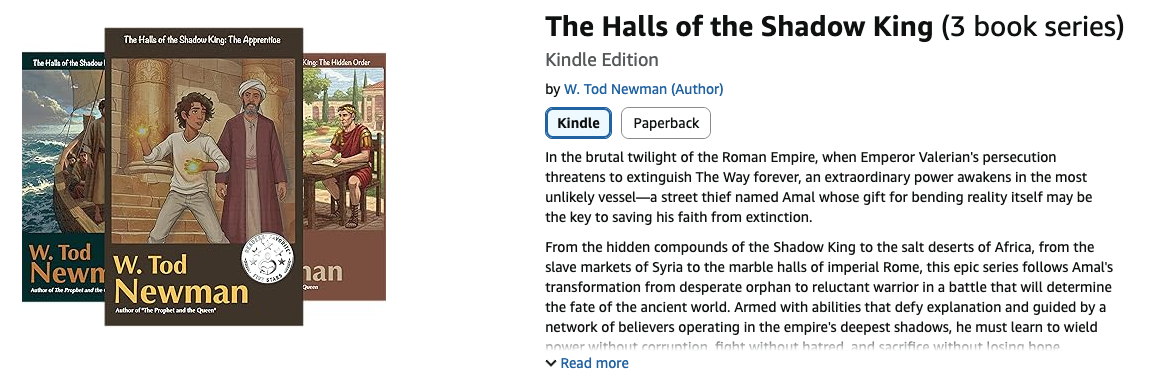
Q&A for the Author of The Halls of the Shadow King

Screen capture from Amazon on Halls of the Shadow King

Q&A with W. Tod Newman, Author of The Halls of the Shadow King

Being a full-time author means dealing with a strange paradox.

No one outside your immediate circle will ever read your book without marketing. For introverted authors who loathe self-promotion, this stinks. But I’ve accepted it as necessary. Most of us write because we believe we’re offering something valuable—entertainment, wisdom gleaned from experience, or both. That value disappears if we never reach the right readers.

I’ve also learned that there are sadistic people out there who find great satisfaction in tearing down authors through anonymous one-star reviews. Often these come from individuals who never bought or read the book. I’ve heard stories of authors receiving one-star reviews describing entirely different books from the one they wrote. Amazon rarely removes these unless they’re extreme violations. They’ll tell you it averages out eventually.

Getting actual readers to leave reviews? Nearly impossible. Whole industries exist around “review farming” to manufacture early buzz for new releases. I find this distasteful.

So here’s my attempt at a different approach—a Q&A based on questions people have actually asked me. Maybe some stray Google search will bring an interested reader this way. Stranger things have happened.

Question: How did you come up with the idea for The Halls of the Shadow King series?

Most authors writing Young Adult series don’t start with AD 280 in the Roman Empire. This choice reflects my love of research—after writing two novels set during the Old Testament prophets, diving into this era was easy and enjoyable.

But the idea came as a question: “What would have happened if the powerful gifts seen in the early church had manifested during Roman persecution?” The timing seemed obvious. Emperor Valerian launched unusually harsh persecutions that began suddenly and ended just as suddenly under his son. My research never turned up a compelling reason why.

Amal emerged as the answer to that question—a gifted young man drawn from street crime in Damascus into a secretive organization dedicated to furthering The Way. His gift combines elements I’ve seen scattered through legends worldwide. Why not place a character who can reshape reality at the center of world-changing events?

Question: Is Amal a perfectly powerful character like Superman?

I struggled to keep Amal human. I don’t enjoy all-powerful, all-good characters in literature. Besides his extraordinary gift, I gave Amal something perhaps more valuable: humility.

Where did this come from? Partly from the kindness of his Creator, but also from making mistakes and learning his capacity for error. He never feels fully confident to me, which makes him real.

If anyone actually reads this and engages, I’ll keep writing these Q&A pieces until people get sick of it!

Want to Check out the SERIES? Head over to my store (product is fulfilled from Lulu.com, which makes a nicer paperback product than Amazon).

Question: Why do you love writing so much?

I’ve asked myself this since high school. Writing was something I kept pushing forward on despite never being satisfied with the output. Eventually I started appreciating my own style and discovered that I could finally complete works I’d started and abandoned. The Halls of the Shadow King is an example—I wrote about half of it between 2016 and 2018, then let it rest. After publishing my two Old Testament prophet novels in the 2020s, I returned to “Halls” and found I could finally tell Amal’s story the way it needed to be told.

But why do I love it?

I write because I like to share. What I’ve learned and gradually understood about life might be transferable to others. My reading taste has always leaned toward the classics, where authors were less distracted by material things (and iPhones!) and more focused on sharing their wisdom, their hearts, and their imaginations.

I think readers may detect this influence in my writing. I hope it has a good effect.

OTHER LINKS about this Series

Reviews from Readers’ Favorite

UP NEXT in the Series

COVER ART process. Yes, I do my own covers (not AI).

BEHIND THE SCENES of the making of the series

Reviews of “The Halls of the Shadow King: The Apprentice”

Readers' Favorite 5-star seal

Here are a few of the professional reviews I’ve received on the first book in the series. I’m not really obsessed with reviews or marketing my books, but I won this review package in a Independent Book Contest and figured I ought to repost. They were all 5-star reviews… Readers’ Favorite does seem to give a fair number of 5-star reviews, but it’s hard to know the percentage since they don’t post anything lower than 4-star. Still, maybe good?

Find the Full Series on Amazon HERE

Reviewed by Jamie Michele for Readers’ Favorite

The Halls of the Shadow King: The Apprentice by W. Tod Newman follows Amal, an orphaned street thief in third-century Syria, fighting to keep his younger sister Neffie alive in a harsh and unforgiving world. When slave traders take her, he discovers a remarkable ability to reshape reality, altering outcomes and alliances in ways others cannot. His daring rescue of dozens of enslaved children draws the attention of the Shadow King, who leads a network safeguarding followers of The Way across the Roman Empire. As Emperor Valerian intensifies the persecution of bishops and believers, Amal is tasked with infiltrating Rome and influencing the emperor. Guided by sages and strategists, he must master his powers while confronting ancient, formidable forces that threaten the empire and the survival of The Way. “That is the balance we all must find – between power and restraint, between action and wisdom. Today you learned more about both than a hundred lessons could have taught you.”

The Halls of the Shadow King: The Apprentice by W. Tod Newman is a really ambitious undertaking, but the author handles it well. I love the contrast of scale, authority, and vulnerability. Amal and Neffie are small children entering spaces filled with political and mystical authority, and we quickly learn that Amal, as a seemingly powerless protagonist, is about to navigate a complex, threatening world. The world-building itself is phenomenal. Newman constructs a richly layered world with cultural, historical, and mystical dimensions. References to both tangible and legendary histories suggest that Amal’s experiences are part of a broader continuum. The inclusion of diverse locations and scholarly networks, like the Alexandrian manuscripts and the Wanderer’s travels, anchoring these elements in a historical context, got me wondering how, through Amal, visions and altering events will shape future outcomes. Overall, this is a solid first entry into the new series, and I look forward to seeing what comes next.

Reviewed by Makeda Cummings for Readers’ Favorite

Amal, a young street orphan and thief, begins life under the cruel hand of the Roman Empire. His existence is one where Christians face persecution and slavery. When his sister, Neffie, falls prey to slave traders, Amal sets out on a harrowing quest to save her. Along the way, strange supernatural powers begin to stir inside of him when the dangers close in. Gradually, Amal’s journey draws him deeper along a secret path called The Way. Ultimately, he is guided by an enigmatic spiritual leader called the Shadow King. Soon enough, he meets friends and foes who force him to value the power of trust while embracing his true purpose. With time running short, Amal stands between light and darkness. Will his inner strength guide him toward freedom or plunge him deeper into the shadows? Find out in W. Tod Newman’s The Halls of the Shadow King.

This captivating novel is more than your average YA historical fantasy. It is a story about inner turmoil and resilience. Set against the backdrop of Roman persecution, W. Tod Newman passionately writes about how ordinary people can find extraordinary strength to do brave things when faced with oppression and suffering. Through Amal’s eyes, readers will bear witness to how spirituality, power, and self-identity can clash in a world dictated by secrets and hidden threats. I’m genuinely amazed at how well the story merges real history and magical elements, making Amal’s encounters both believable and exciting to follow. The author knows how to create characters that come alive and stand out throughout the book. Each character, from the Shadow King to Amal and Gallien, conveys different ways people respond to issues like fear and control. From beginning to end, The Halls of the Shadow King challenges readers to think about the price of truth and what it means to withstand internal and external darkness. It truly is a literary gem.

Reviewed by Isabella Harris for Readers’ Favorite

The Apprentice by W. Tod Newman is the first installment in The Halls of the Shadow King series. Set during the Roman era, Amal, a young street thief, is searching for his sister, whom he believes has been kidnapped by slavers. During his search, he is overwhelmed by an extraordinary power that grants him the ability to reshape reality. He uses this power to successfully rescue his sister, with other children held hostage by the slavers, leading them to seek refuge in a community of worshippers called The Way. Unfortunately, the followers of The Way Amal are being threatened by the Roman Empire, which strongly opposes their beliefs. With Amal’s newfound powers, the fate of their beliefs now rests on his ability to understand and harness his extraordinary gift.

I was really impressed by how W. Tod Newman was able to blend a historical setting with faith and mysteries. The Halls of the Shadow King shows the reign of the Roman Empire and the struggle the followers of The Way suffered at the hands of the Romans. I loved how remarkably the characters were developed, especially Amal, who goes from a young street thief to someone on whose shoulders the fate of an entire religion lies. The pacing kept me engaged, which allowed me to fully understand Amal’s motivations and his journey of fully harnessing his powers. The Halls of the Shadow King: The Apprentice covers themes of humility, determination, greed, deceit, and much more. I recommend it to readers who are interested in historical fiction with a touch of extraordinary mystery.